Tuesday, May 30, 2006
Consultation invited on new Therapeutics Regulation
ANZTPA is inviting submissions on the proposed regulatory scheme or "draft Rules" for medicines and medical devices; a description of the proposed Grouping Order for medicines; draft guidelines on transition provisions for product licensing; the key components of the draft Administration Rule; and the consultation document on the proposed fees and charges.
The closing date for submissions on the consultation documents is 15 August 2006.
NSW bans soft drinks in school canteens
The NSW Government has moved to ban soft drinks from school canteens following the findings of a new health report that details a disturbing rise in the levels of childhood obesity.This measure, which will clearly have impact on oral health also, was announced on 24 May 2006 by the NSW Premier, Morris Iemma, Minister for Health, John Hatzistergos and the Minister for Education and Training, Carmel Tebbutt.
The release notes that "One glass of soft drink contains almost 10 teaspoons of sugar, and this survey shows that almost six in 10 boys and four in 10 girls drink more than one glass of soft drink a day".
The Victorian Minister for Education, Lynne Kosky announced a similar ban in Victorian school canteens, which was reported in an ADAVB Blog posting on 24 April.
Thursday, May 18, 2006
Feedback invited on Draft Board Policy and Code
- review of the DPBV Code of Practice on After Hours Services: and
Tuesday, May 16, 2006
New Council to take office on 19 June
In accordance with Rule 39(1) where, “in the event of the nominations being not more in number than the positions to be filled, those who have been nominated in accordance with the above shall be deemed to be elected, and shall assume and commence office on the expiration of the term of office of the outgoing members of the Council”, the following seventeen nominees have been declared elected without ballot. Congratulations to:
Dr Andrew Barnes
Dr Mark Bowman
Dr Chris Callahan
Dr Stephen Cottrell
Dr Pamela Craig
Dr David Curnow
Dr Bob Cvetkovic
Dr Anne Harrison
Dr Neil Hewson
Dr David Houghton
Dr Matthew Hopcraft
Dr John Matthews
Dr Greg Morris
Dr Ming Ann Ong
Dr Anne Stewart
Dr Jonathan Tversky
Dr Gary Yip
These new Councillors will meet on 19 June to elect the new officer bearers for the coming year, and they will all take office from the end of the June General Meeting, which is also scheduled for 19 June.
Wednesday, May 10, 2006
Australian HES article re graduate entry
ADA Inc. responds to Federal Budget
More Budget news re Superannuation
- Self-employed to receive 100% tax deduction and co-contributions
- Aged-based limits abolished
The self-employed are to be treated the same as employed people in that the $5000 +75% deduction rule is being removed. In addition, the co-contribution will be extended to post-tax contributions made by the self-employed.
Also, the Maximum Deductible Contribution (MDC) limits are to be abolished from 1 July 2007 and replaced with a new annual contribution limit of $50,000. There is to be a transitional period for those 50 and over who currently have an MDC of $100,587, but more details are still awaited on this. Those under 35 will enjoy a $35,000 increase in their MDC, and 35 to 49 year olds will have an approximately $10,000 increase.
The ability to make deductible superannuation contributions is to be extended to age 75 (up from age 70).
Thanks to Moneywise and Challenger for drawing these changes to attention.
Practice activity patterns of dentists in Australia
These changes in oral health, demographics and use of services are expected to continue to affect the practice activity patterns of dentists, the report says.
Dr David Brennan of the AIHW's Dental Statistics and Research Unit based in the Australian Research Centre for Population Oral Health at the University of Adelaide, said retention of natural teeth is becoming increasingly common, as early detection of dental problems becomes more routine.
"This raised expectation for retaining a healthy natural dentition for life is likely to see sustained demand for the services of dentists both currently and into the future", he said.
While check-up was the most common reason for a dental visit (48.4%, 41.1% and 43.2% at each survey interval), the percentage of patients seeking pain relief decreased over time from 31.4% to 26.7%.
The percentage of patients who were seeing the dentist for follow-up or maintenance care increased for all patients. The numbers of different diagnostic services also increased over time among most patient age groups, but especially among the 65 and overs, which increased from 46 diagnostic services per 100 visits to 67 diagnostic services per 100 visits, reflecting increased rates of both dental examinations and x-rays. Crown and bridge services also increased.
The Federal Budget and Dentistry
ADA Inc. submission on Graduate Entry
The conclusion to that submission notes that:
Although the Bologna Process highlights medium and long-term challenges (and opportunities) for the Australian higher education system, there are anumber of short-term considerations with respect to the education of dentists that the ADA regards as requiring immediate action by the Australian Government. These have been outlined previously and can be summarised as follows:
Some of the ADA’s concerns would be addressed if:
The ADA urges the Australian Government to give full consideration to these issues. While Australia must consider higher education reforms in the broader international context, immediate concerns must be this country’s first priority."
ADAVB 2006 Convention Sold Out !
Tuesday, May 09, 2006
AMA's Informed Financial Consent Advice
More about Private Health Insurance changes
"The changes that have been agreed include:
- the introduction of legislation to allow, but not require health funds, to offer Broader Health Cover products;
- the proposed mainstreaming of the Outreach Hospital in the Home services will be suspended pending the introduction of Broader Health Cover;
- the regulation of products, rather than health funds, which will involve the private health insurance rebates attaching to products rather than a health fund registration;
- the introduction of uniform safety and quality criteria so that in the future all privately insured services will be provided by an accredited facility and/or suitable qualified provider;
- the removal of Lifetime Health Cover (LHC) loadings for members who have held private health insurance on which they have paid a loading for 10 years continuously;
- Medicare Australia, as part of business as usual, will write to people who do not have private health insurance and are about to be affected by LHC, reminding them of their LHC deadline and that they may incur a LHC loading;
- a requirement being placed on health funds to provide, for each product they sell, standard product information about:
- premiums;
- waiting periods;
- exclusions;
- hospital and medical gaps; and
- excesses. - support for the establishment by the Private Health Insurance Ombudsman of a website that will allow people to compare health funds and their products and provider arrangements. The standard product information will be required to be provided to the Ombudsman for publication on the website; and
- the implementation of risk equalisation (reinsurance) reforms that will include:
- the implementation of a modified industry model for risk equalisation;
- a high cost claims pool; and
- the treatment of single parents as 1 Single Equivalent Unit."
Certain of these changes are expected to have direct impact on the way some dental services are funded. Historically dental services were only covered under ancillary benefits tables, but from 1 April 2007 "health funds will be able to offer products that pay benefits for services that are part of, prevent, or substitute for hospital services, removing the current boundary that exists between “hospital” and “ancillary” insurance".
Thursday, May 04, 2006
New food labelling system welcomed
Wednesday, May 03, 2006
Graduates choose rural life
Monday, May 01, 2006
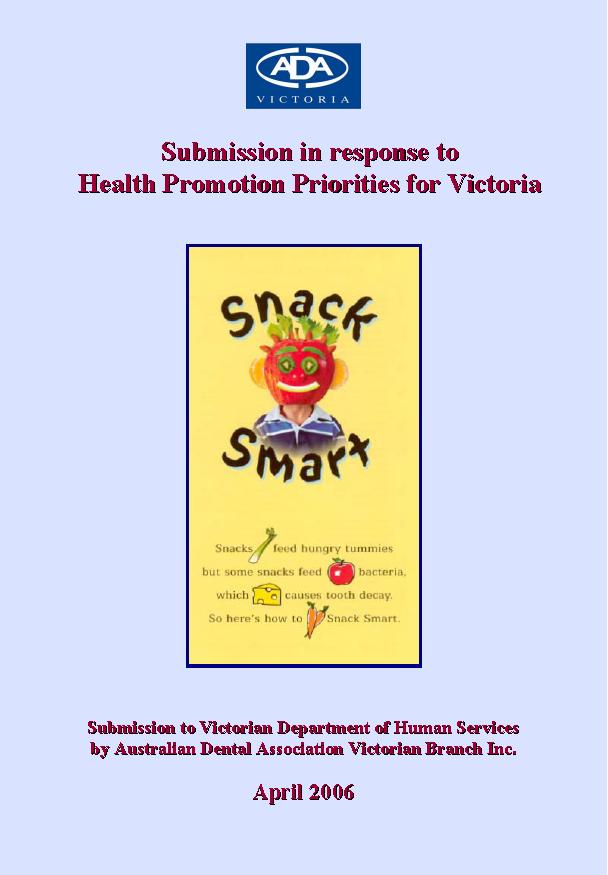
Health promotion priorities submission
The Victorian Department of Human Services recently published a discussion paper on Health Promotion Priorities for Victoria, and invited submissions from interested persons.The ADAVB submission in response to this initiative is now available.
Our submission calls for a higher profile to be given to oral health promotion - either by adjustment of the Department's currently proposed priority areas, or the addition of one or more extra areas which can accommodate the need for more oral health promotion.
Dental caries and periodontal (gum) disease are amongst the most prevalent and expensive health conditions, and yet most such disease is preventable. Oral health risk factors are similar to those for chronic and systemic diseases like diabetes and heart disease. This makes it an ideal area for health promotion interventions.
Once the Department has finalised its health promotion priorities for the period 2007-2012, we will publish update information here.